

House Bill 846: What Is Ohio’s Proposed Domestic Violence Registry?
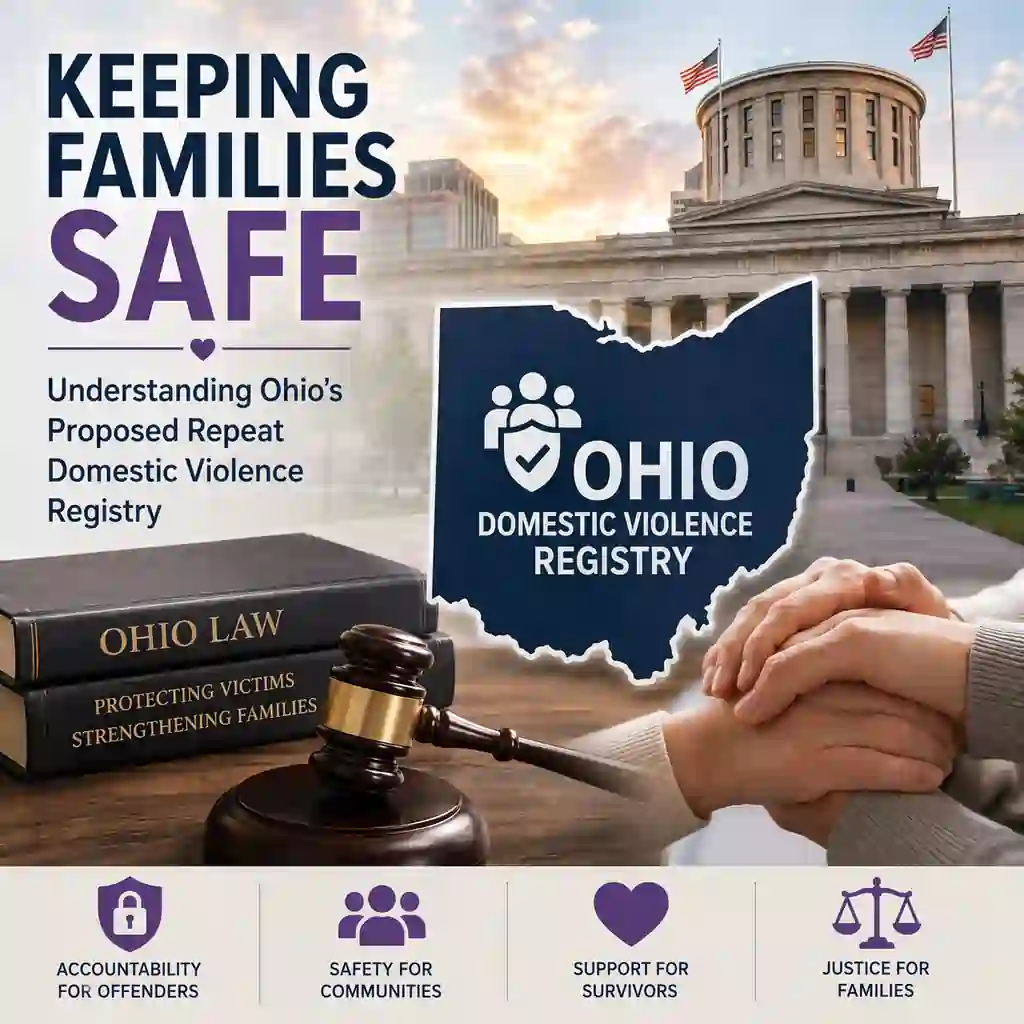 In Ohio’s proposed domestic violence registry is drawing statewide attention as lawmakers consider House Bill 846, legislation that would create a public registry for repeat domestic violence offenders. Designed to improve public safety and help protect survivors, the proposal would establish a statewide database similar in concept to Ohio’s existing sex offender registry. Aimed at protecting survivors and preventing future tragedies, House Bill 846 proposes the creation of a statewide registry for repeat domestic violence offenders—a system that would operate similarly to the existing sex offender registry.
The proposed Ohio domestic violence registry would operate similarly to the state’s existing sex offender registry. The bill, spearheaded by a bipartisan group of lawmakers including Representatives Phil Plummer (R-Dayton) and Crystal Lett (D-Columbus), seeks to provide the public and law enforcement with a vital tool to identify individuals with a history of domestic violence.
How Would the Law Function?
Modeled after a Tennessee law, the registry would be monitored and maintained by the Ohio Bureau of Criminal Investigations (BCI). Under this bill, individuals who are convicted of a violation of Ohio’s domestic violence law two or more times will have to register on the public database.
The database would display:
- The offender’s name and photo
- Date of birth
- Location of their conviction
Unlike the sex offender registry, this database would not include the offender’s specific home address or other highly sensitive personal information. The length of time an offender remains on the list depends on the number of convictions:
- Two convictions: At least two years on the registry.
- Three convictions: At least five years.
- Four or more convictions: At least ten years.
Ohio’s domestic violence law currently bans individuals from knowingly or recklessly causing physical harm to a family or household member, or causing a household member to believe they will be physically harmed. If an individual has a prior conviction of domestic violence, a subsequent instance of violence is charged as a Fourth Degree Felony (at minimum).
Public Access and Legal Context
Criminal records in Ohio remain available to the public unless they are sealed, expunged, or pardoned. However, domestic violence felonies are generally not sealable, and a pardon oftentimes cannot be sought until ten years following a conviction. Therefore, while much of this information is technically already a matter of public record, the proposed registry would consolidate it into a single, accessible location.
The registry may make it easier to find an offender than searching through court websites; lawmakers emphasize that if the registry saves even one life, it is a success. The proposed Ohio domestic violence registry would centralize information already available through public court records.
Beyond the Registry: Domestic Violence Prevention
While a public registry is a significant reactive tool, experts and researchers suggest that addressing domestic violence requires a multi-faceted approach that targets the root causes of abuse. According to a review in the National Library of Medicine, domestic violence can be stopped before it begins by understanding and mitigating specific risk factors.
Research indicates that traditional misconceptions, low literacy levels, poor knowledge about women’s rights, and a lack of social support for survivors can lead to various forms of domestic violence. To move from reaction to prevention, the study highlights several effective strategies that have been globally proven to effectively prevent domestic violence:
- Nurse-Family Partnerships (NFP): One of the most effective interventions involves “Nurse Home Visits.” In these programs, trained nurses visit high-risk pregnant women and young mothers to provide health education, mitigate risk factors, and inform them about the consequences of intimate partner violence. Studies have shown this can lead to a nearly 50% reduction in physical and psychological violence.
- Economic Empowerment: There is a direct link between financial independence and safety. Interventions that combine business training and microfinance support help women gain the economic status necessary to leave abusive situations and reduce the power imbalances that often fuel domestic abuse.
- Internet-Based Safety Aids: Web-based safety decision tools allow survivors to privately assess their risk levels and access mental health resources. These “decision aids” have been proven to reduce exposure to violence by empowering survivors with actionable safety plans. (See Free and Confidential Hotline)
- Relationship Skill Education: Programs like the “Building A Lasting Love” (BALL) intervention focus on teaching young couples the signs of healthy versus unhealthy relationships, problem-solving techniques, and personal relationship skills before patterns of abuse become entrenched.
The proposed Ohio domestic violence registry is a bold step toward accountability. However, as the research suggests, the most effective way to protect Ohio families is to pair legal consequences with community-based programs that address education, financial stability, and early intervention. By identifying offenders and supporting survivors simultaneously, Ohio can pour resources into the community and survivors to prevent, and mitigate damages following domestic violence.
If enacted, the Ohio domestic violence registry could become another important resource for Ohio families.
If you or someone you know is experiencing domestic violence, or believes they may be experiencing domestic violence, please visit the Ohio Domestic Violence Network for more information and resources. If your family has been affected by issues related to the Ohio domestic violence registry, domestic violence allegations, or divorce, an experienced family law attorney can help.
Publisher’s Note:
I want to thank Rachel Zagorski for writing this post! Rachel is clerking with MuesLaw for the Summer. She will be starting her final year at the University of Dayton School of Law in the Fall. We are glad you are working with us! You will be reading more posts written by Rachel soon!
MuesLaw Provides Experienced, Trusted and Professional Advice if You Are Considering Ending Your Marriage.
Our team can help you to protect your interests and move forward peacefully. MuesLaw can assist you with your divorce, dissolution and parenting/custody related issues. To learn more, please go to our website at mueslaw.com or call us at (937) 293-2141. We can schedule an in-person conference or one by phone or Zoom. We look forward to assisting you!
Please consider joining or following us!


© 2026, Ohio Family Law Blog. All rights reserved.

Attorney Robert “Chip” Mues has been focusing his legal practice throughout Southwest Ohio primarily in divorce and family law matters since 1978. Chip is passionate about family law and has proudly published the Ohio Family Law Blog since 2007. In addition, he previously managed the Dayton law firm of Holzfaster, Cecil, McKnight & Mues LPA until it dissolved on December 31, 2024. He founded MUESLAW in 2025. To learn more about him or MUESLAW, visit www.MuesLaw.com. Appointments are available in person, over the phone or by Zoom. Call us at 937 293-2141. He can be contacted by email at chip@mueslaw.com.