
Why Dissolution vs Divorce in Ohio Matters for Your Family
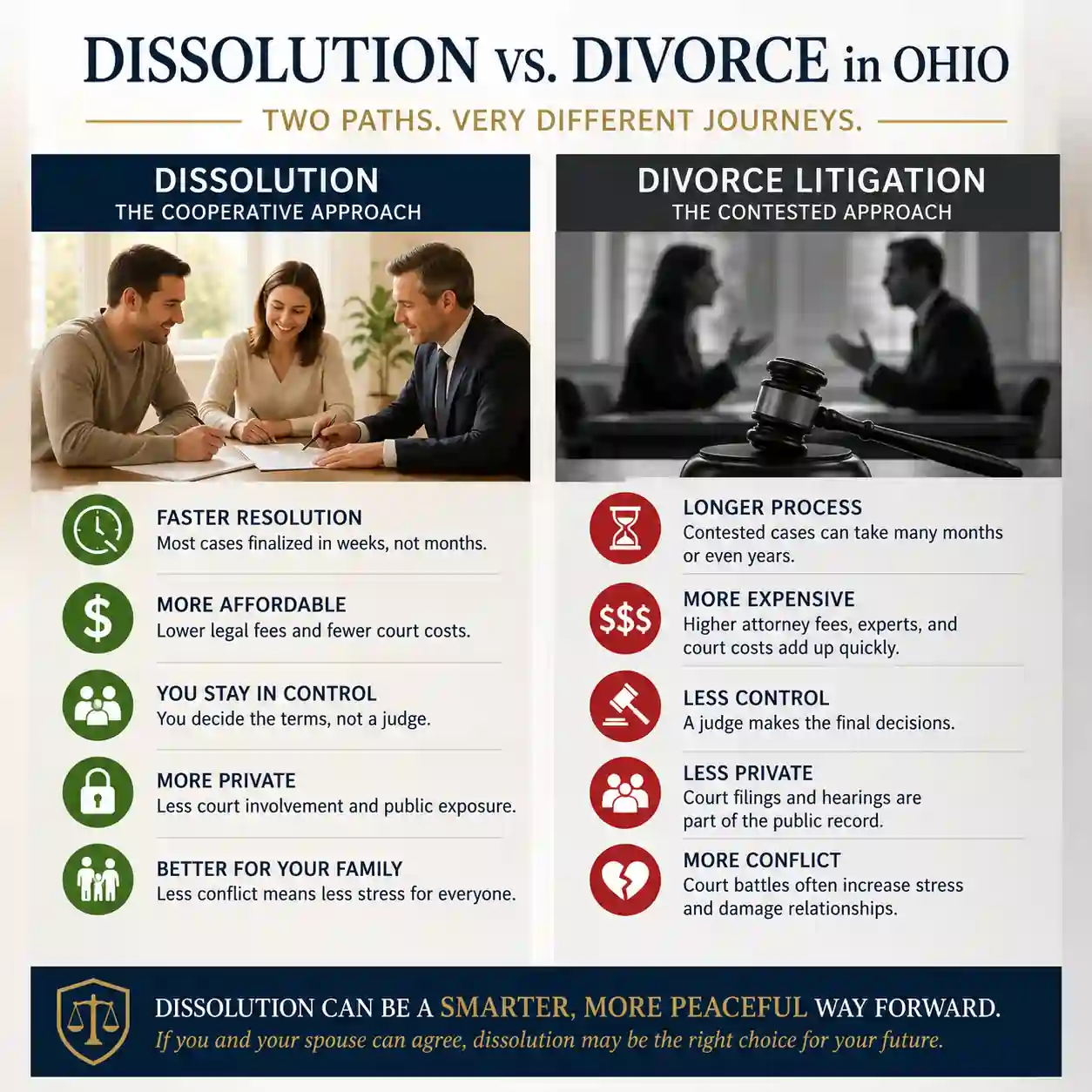 Considering divorce in Ohio? Learn why dissolution is often faster, more affordable, and more private than divorce litigation – and when it may be the right option for your family. Understanding dissolution vs divorce in Ohio is essential for couples deciding how to legally end their marriage. While both options terminate a marriage, they differ significantly in cost, process, and level of court involvement.
When a marriage ends, many people assume divorce is the only option. But in Ohio, there is another path that is often faster, less expensive, and far less stressful: dissolution of marriage.
At MuesLaw, we regularly meet with people who are overwhelmed by the idea of going to court, spending thousands of dollars on litigation, and putting their private family issues on display. The good news is that for many couples, there is a better solution.
If you and your spouse can reach agreement on the major issues, dissolution may be the most efficient and controlled way to end your marriage – without the drawn-out process of a contested divorce.
Below, we explain what dissolution is, how it differs from divorce, and why it is often the smarter option for Ohio families.
What Is a Dissolution of Marriage in Ohio?
An Ohio dissolution is a legal process that ends a marriage when both spouses agree on all issues, including:
- Division of assets and debts
- Spousal support (alimony), if any
- Parenting time and custody arrangements
- Child support and related expenses
Instead of fighting these issues in court, the spouses sign a Separation Agreement and, if children are involved, a Shared Parenting Plan or parenting arrangement. Then, the court schedules a brief final hearing to approve the agreement and terminate the marriage. That hearing is typically scheduled for the final hearing in about 6 weeks after the filing of all the required documents.
In most dissolutions, there is no trial, no courtroom battle, and no need to “prove” wrongdoing.
Dissolution vs. Divorce in Ohio: What’s the Difference?
Many people confuse dissolution and divorce because both end a marriage. But the process is very different:
Divorce in Ohio (Litigation)
A divorce typically involves:
- formal court filings
- temporary orders
- discovery and subpoenas
- hearings and motion practice
- potential trial
If spouses disagree, the judge ultimately decides the outcome. Click here to read a blog about all the facets of a typical high conflict divorce action.
Dissolution in Ohio (Agreement-Based)
A dissolution typically involves:
- negotiation
- written agreements
- one final court appearance
- a faster resolution
The key difference is simple: Divorce is decided by a judge. Dissolution is decided by you.
7 Reasons Dissolution Is Often the Better Option in Ohio
While every situation is different, dissolution offers major advantages – especially for couples who want a clean and efficient end to the marriage.
1. Dissolution Is Usually Much More Affordable
Litigated divorce can become extremely expensive. Attorney fees in Ohio often range from $300 to $400+ per hour, and contested cases can quickly balloon into tens of thousands of dollars. When comparing dissolution vs divorce in Ohio, the biggest difference is who controls the outcome: the couple or the court. Click here to read a post about the average costs for a contested divorce last year.
Dissolution is generally far less expensive because:
- fewer court appearances are needed
- there is no contested litigation
- the case is resolved efficiently
If your goal is to protect your finances during an already difficult time, dissolution can be the most cost-effective option.
2. Dissolution Gives You Control Over the Outcome
When you litigate a divorce, you are putting your future in the hands of a judge who:
- does not know your family
- does not know your finances beyond what is presented
- may only hear a limited snapshot of your life
In dissolution, you and your spouse decide what is fair and workable. This often results in more practical agreements regarding:
- parenting schedules
- holidays and school breaks
- retirement accounts and buyouts
- real estate division
- debt allocation
In short, dissolution allows couples to craft a plan that actually fits their lives.
3. Dissolution Is Faster Than Divorce Litigation
Ohio divorces can take months – and in contested cases, sometimes over a year.
Dissolution is often resolved far more quickly because there is no prolonged court battle. Once the agreement is filed, the court schedules a hearing usually in about 6 weeks!
For many people, speed matters. A quicker resolution means:
- less uncertainty
- less emotional strain
- fewer disruptions to children
- faster ability to move forward financially and personally
4. Dissolution Reduces Conflict (Especially When Children Are Involved)
If you share children, your relationship with your spouse does not end when the marriage ends. You may still need to coordinate:
- school issues
- medical decisions
- extracurricular activities
- holidays and vacations
- future milestones like graduations and weddings
Litigation tends to increase hostility, and children often feel the impact of that conflict. Dissolution encourages cooperation and communication – two things that are essential for successful co-parenting.
5. Dissolution Protects Your Privacy and Reputation
Divorce litigation often requires:
- sworn allegations
- courtroom testimony
- public filings that can become part of the court record
For professionals, business owners, or anyone concerned about reputation, this can be a major issue.
Dissolution generally involves fewer public disputes, fewer hostile accusations, and a more discreet process overall.
If your goal is to end your marriage without unnecessary public exposure, dissolution can be a better route.
6. Dissolution Can Protect Your Business and Financial Stability
For business owners, divorce litigation can become extremely disruptive. Contested divorce cases often involve:
- business valuations
- subpoenas for financial records
- forensic accounting
- disputes over income and cash flow
Even if the business survives, the process can drain time, money, and energy. Dissolution often allows couples to negotiate practical solutions such as:
- structured buyouts
- fair division of business interests
- keeping the business intact
- protecting ongoing operations
A negotiated dissolution can prevent the divorce process from damaging the very asset you worked on to build.
7. Dissolution Avoids the “Win-Lose” Courtroom Dynamic
In a litigated divorce, each spouse is often focused on “winning.”
That mentality can cause:
- unnecessary conflict
- escalating attorney fees
- bitterness that lasts for years
- poor long-term co-parenting outcomes
- poor long-term co-parenting outcomes
Dissolution is not about winning – it is about resolving. When both spouses leave the process feeling the outcome is fair, they are more likely to comply with the agreement and move forward without ongoing disputes. Click here to read a prior post also discussing the differences between a divorce and dissolution.
When Dissolution Is NOT the Right Choice
It is important to be realistic: dissolution is not appropriate for every marriage.
You may need a traditional divorce if:
- there is domestic violence or coercive control
- one spouse is hiding assets
- one spouse refuses to cooperate
- there is severe addiction or mental health instability
- there is a serious power imbalance in negotiations
In these cases, court involvement may be necessary to protect one spouse or the children. A good family law attorney will be honest with you about whether dissolution is a safe and realistic option.
Dissolution vs Divorce in Ohio: Why You Still Need a Lawyer for an Ohio Dissolution
Many people assume dissolution is “simple” and can be done without legal help. While dissolution is usually smoother than divorce, mistakes can be expensive.
A properly drafted dissolution agreement should address issues such as:
- retirement division and QDRO requirements
- tax consequences
- real estate transfers
- parenting plan language that avoids future disputes
- enforceability of support obligations
If the agreement is unclear or incomplete, it can create conflict later – even if things are amicable now.
Working with an experienced Ohio dissolution lawyer helps ensure your agreement is legally sound, enforceable, and structured to protect your future. For many Ohio families, understanding dissolution vs divorce in Ohio helps clarify that there is often a more efficient and cooperative path forward.
PUBLISHER’S NOTE:
I want to thank Ben Murakowski, who is clerking with MuesLaw this Summer, for researching and writing this excellent blog! Ben will be starting his final year of his legal education at the University of Dayton School of Law in the Fall. Ben is an excellent writer no doubt and we are pleased to have him join our team.
MuesLaw Provides Experienced, Trusted and Professional Advice if You Are Considering Ending Your Marriage.
An experienced divorce attorney can help you to protect your interests and move forward peacefully. MuesLaw can assist you with your divorce, dissolution and parenting/custody related issues. MuesLaw serves clients throughout Dayton, Montgomery County, Greene County, and surrounding Ohio communities. To learn more, please go to our website at mueslaw.com or call us at (937) 293-2141. We can schedule an in-person conference or one by phone or Zoom. We look forward to assisting you!
Please consider joining or following us!


© 2026, Ohio Family Law Blog. All rights reserved.

Attorney Robert “Chip” Mues has been focusing his legal practice throughout Southwest Ohio primarily in divorce and family law matters since 1978. Chip is passionate about family law and has proudly published the Ohio Family Law Blog since 2007. In addition, he previously managed the Dayton law firm of Holzfaster, Cecil, McKnight & Mues LPA until it dissolved on December 31, 2024. He founded MUESLAW in 2025. To learn more about him or MUESLAW, visit www.MuesLaw.com. Appointments are available in person, over the phone or by Zoom. Call us at 937 293-2141. He can be contacted by email at chip@mueslaw.com.