
Medicaid Divorce in Ohio: What You Need to Know
Publisher’s Note:
A potential client was referred to me by a local lawyer to help her initiate a “Medicaid Divorce” as her husband had lost his job, has significant medical issues and outrageous medical bills. She explained that he didn’t qualify for Medicaid because of her income and she is unable to maintain the house and support him. She wanted a divorce but remain together. The call raised all sorts of red flags!
I referred her to the law firm of Demarest + Demarest in Bellbrook to obtain the Medicaid planning advice she desperately needed. We have been partnering with Demarest & Demarest on estate planning, probate, elder law and Medicaid planning matters for almost 2 years. They do EXCELLENT work! I knew they could help her plan and consider other alternatives available.
This call also led me to suggest to Gwen and Cullen Demarest that we write this blog together to perhaps provide the public with some valuable information for those who are experiencing similar hardships.
The Risks of a Medicaid Divorce in Ohio
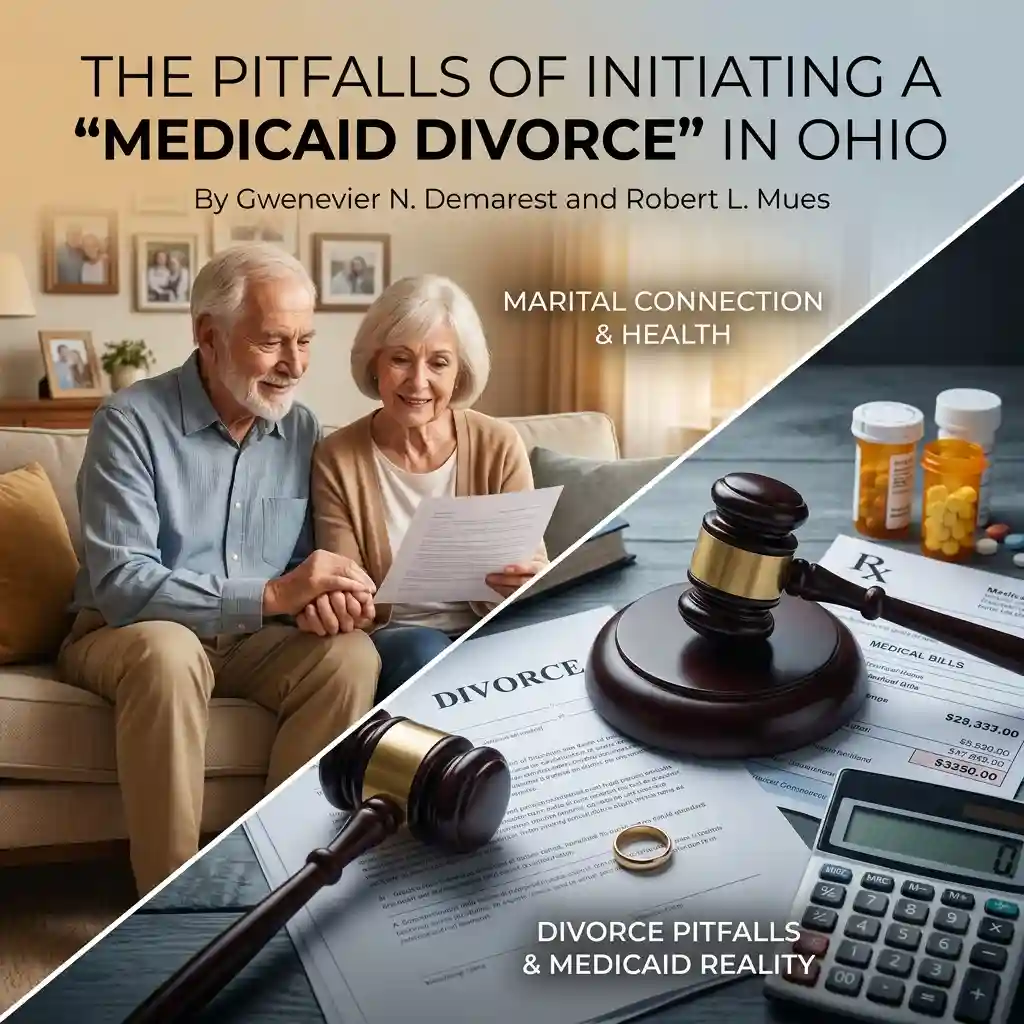 For many couples considering a Medicaid divorce in Ohio, the vow of “in sickness and in health” eventually meets a harsh financial reality: the rising costs of long-term health care. When one spouse requires extensive care such as nursing home stays or in-home assistance, the immense cost of care often leads to a desperate question: Should we get a divorce to protect our assets?
While a “Medicaid Divorce” is a strategy intended to help the non-applicant spouse retain the majority of the couple’s joint assets, it is a high-risk decision that can create more problems than it solves.
Understanding Ohio Medicaid Eligibility
Understanding Ohio Medicaid eligibility is essential before considering a Medicaid divorce in Ohio. Currently, Ohio Medicaid’s long term care coverage is divided into three core programs: (1) Nursing Home Medicaid, (2) PASSPORT Waiver Program, and (3) Assisted Living Waiver Program. Dependent on the program, recipients of Medicaid could receive coverage for in-home care, assisted living care, or nursing home care. These programs, however, come with strict financial thresholds for eligibility. As of 2026, an individual applicant is only permitted to have a gross income of $2,982 per month (300% of the Federal Benefit Rate), and $2,000 in available resources.
This often sparks the question from concerned married couples “how are we going to be able to live on this?” Under Ohio law (Ohio Admin. Code 5160:1-6-04), Community Spouse is protected by the Community Spouse Resource Allowance (CSRA). This allowance permits the healthy spouse to keep one-half of the couple’s joint countable assets, up to a maximum limit of $162,660 for 2026. It also guarantees they can keep at least a minimum base amount of $32,532. Despite this, most married couples, still understandably ask the question “is there a way to protect more?” That is where Medicaid asset protection planning enters the picture.
Alternatives to a Medicaid Divorce in Ohio
Before pursuing a Medicaid divorce in Ohio, couples should explore whether Medicaid planning or other asset-protection strategies could accomplish their goals without ending the marriage. An experienced elder law attorney can often help you implement these strategies effectively:
- Irrevocable Medicaid Asset Protection Trusts (MAPT): Transferring assets into a properly drafted MAPT removes them from your countable estate, while preserving them for your beneficiaries. However, because Medicaid heavily scrutinizes transfers, creating and funding these trusts come with risks of penalties if done within Medicaid’s 60-month look-back period.
- Medicaid Compliant Annuities: If you are facing an immediate need for care and have excess assets, those assets can be converted into an irrevocable, non-assignable income stream for the healthy spouse. Because the healthy spouse’s income is not counted against the applicant, a Medicaid compliant annuity effectively turns excess countable assets into exempt income, instantly accelerating eligibility.
- Strategic Spend Downs: Couples can legitimately spend excess assets on non-countable (exempt) items. This can include paying off a mortgage, making home accessibility modifications, repairing or purchasing a vehicle, or purchasing prepaid funeral and burial contracts.
- Caregiver Agreements: Although evaluated with a fine-tooth comb, when a family member is providing care to the ailing spouse, a legally binding personal care agreement is often a tool used by the experienced elder law attorney. If done correctly, this allows you to compensate the caregiver using your assets, which reduces your countable estate without incurring a Medicaid transfer penalty.
Why Medicaid Planning Matters Before a Medicaid Divorce in Ohio
1. The Look-Back Period & Transfer Penalties
Medicaid analyzes all financial transactions done within the 60-months (five years) leading up to submission of your application, more commonly known as the “look-back” period. Transfers that are scrutinized during the look-back period are those where the individual/couple does not receive the fair market value for the transfer in return. This includes but is not limited to gifting property, transferring funds to relatives, or selling assets for prices below their market value. If a divorce settlement grants the non-applicant spouse a disproportionate share of the marital assets, Medicaid may view this as a “transfer for less than fair market value,” leading to potential penalties, known as restricted Medicaid coverage periods, for the applicant.
Furthermore, spousal support may be used to help pay Medicaid bills. The Sixth District Ohio Court of Appeals held in Coker v. Ulch (2006) that Medicaid requires individuals to utilize all available income – spousal support is considered income. The Court determined that relieving an ex-spouse of spousal support obligations would shift the burden to taxpayers to care for the Medicaid-eligible spouse, which is against public policy. Even in the event of a divorce, a court may compel the healthy spouse to still provide financial support to Medicaid-eligible spouse, potentially defeating the purpose of divorcing to protect assets.
2. Collateral Damage
Obtaining a Medicaid Divorce may result in the loss of various rights afforded to married couples, including retirement benefits, inheritance protections, and favorable tax treatments. For example, divorcing strips the healthy spouse of the unlimited marital deduction for estate and gift taxes, forces the forfeiture of survivors benefits on pensions or Social Security (especially if the marriage lasted less than 10 years), and typically terminates spousal coverage under employer-sponsored health insurance plans.
Furthermore, a Medicaid Divorce can lead to the loss of caregiver rights and the right to make medical decisions. Following a divorce, a spouse may lose the legal standing to make medical decisions for their spouse when necessary, unless proper planning is put in place. This may be particularly imperative as the applicant spouse’s health worsens and requires long-term care.
Ohio law requires that a divorce or dissolution is pursued with a legitimate intent to separate and end a marriage. Filing for divorce or dissolution solely to gain financial advantage, can lead to the separation as being seen as a “sham” divorce. Separation Agreements and Divorce Decrees function as binding contracts – couples must enter them in good faith. (See In Re Whitman). By entering into a divorce or dissolution, an individual agrees to the terms of the contract and must intend to end the relationship. A couple going through with a divorce without intending to terminate the relationship may be considered fraudulent and could lead to significant legal consequences.
These potential consequences are particularly important for couples considering a Medicaid divorce in Ohio, because the decision to end a marriage can affect far more than Medicaid eligibility.
Summary
A Medicaid divorce in Ohio is a last resort that is rarely necessary, especially if you plan ahead. Because Medicaid rules vary wildly by state and are subject to strict look-back scrutiny, you should never attempt to reallocate assets without professional guidance.
If you are concerned about qualifying for care while protecting your spouse’s future, consult with an experienced elder law attorney.
MuesLaw Can Help!
The team at MuesLaw is committed to providing our clients with excellent individualized representation and sound legal advice. Feel free to learn more about us at our website at www.MuesLaw.com. If you live in the Dayton or Southwestern Ohio area and are considering a divorce or dissolution, please contact MuesLaw at (937) 293-2141 or by email at info@MuesLaw.com. We will gladly work with you and address any questions or concerns you may have about this process. We offer phone, Zoom, and in-person consultations.
About Guest Co-Author Gwen Demarest:
 Demarest & Demarest Attorneys at Law is a husband-and-wife law firm located in Bellbrook, Ohio offering services in estate planning, elder law, Medicaid planning, probate, and business law.
MuesLaw has been co-counseling with Gwen and Cullen Demarest for nearly two years now. They provide excellent legal advice to their clients! Their main office is located at 34 E. Franklin St., Bellbrook, Oh 45405. They can be reached at (937) 310-1515, and their email is intake@demarestlawllc.com. Their website provides a lot of excellent information. Check it out at Demarest & Demarest LLC
Please consider joining or following us!


© 2026, Ohio Family Law Blog. All rights reserved.