
Artificial Intelligence and Family Law: Convenience Comes with Consequences
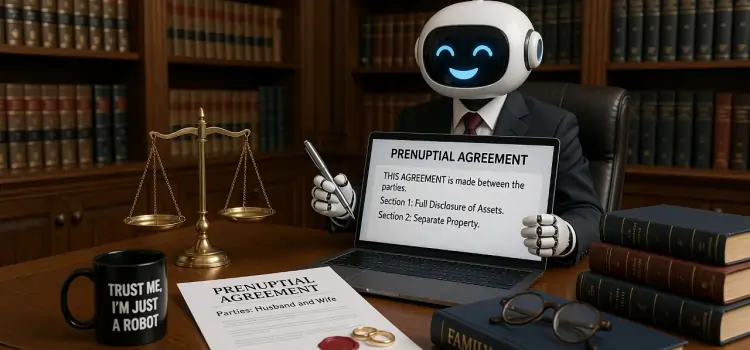
 Artificial intelligence is changing the way people access information. Today, anyone can log into an AI platform and ask it to draft an AI prenuptial agreement, prepare a separation agreement, or even generate documents for a marriage dissolution. The technology is fast, inexpensive, and readily available.
For many people, that sounds appealing. Why pay an attorney when a computer can produce a document in a matter of seconds?
The answer is simple: drafting legal documents is not merely a matter of filling in blanks. Family law matters involve the intersection of multiple legal disciplines, personal circumstances, financial realities, and long-term consequences that artificial intelligence simply cannot fully appreciate.
Before trusting AI with one of the most important legal documents you will ever consider signing, it is worth understanding both the advantages and the limitations of the technology.
The Benefits of an AI Prenuptial Agreement
To be fair, artificial intelligence does offer some benefits.
- Cost Savings
The most obvious advantage is cost. AI platforms are often inexpensive or free compared to hiring an attorney.
- Speed
AI can generate a draft document almost instantly. What might take a person hours to prepare can be produced in seconds.
- Accessibility
Many individuals use AI as a starting point to learn about legal concepts, identify issues they may not have considered, or organize information before meeting with an attorney.
- Educational Value
AI can help explain legal terminology and provide general information about family law procedures. For someone unfamiliar with the legal system, this can be a useful introduction. These benefits are real. However, they are also the point at which many people begin to overestimate what AI is capable of doing.
Why an AI Prenuptial Agreement May Not Protect You
A prenuptial agreement is not simply a contract.
A dissolution is not simply a collection of forms.
Each document carries legal consequences that may affect property rights, spousal support, inheritance rights, tax obligations, parental rights, and future litigation. The challenge is not drafting language. The challenge is understanding how the law applies to the unique facts of a particular person’s situation. That is where attorneys provide value that artificial intelligence cannot replicate. An AI prenuptial agreement may look complete on paper but still fail to protect your legal interests.
Attorneys Are Trained to See Legal Issues AI May Miss
When people think of family law attorneys, they often imagine someone who only knows divorce law. Attorneys draw upon knowledge from numerous legal disciplines that frequently overlap in family law cases.
Contract Law
Whether prepared by an attorney or generated as an AI prenuptial agreement, prenuptial agreements are contracts.
An attorney understands how courts evaluate contract formation, unconscionability, consideration, disclosure requirements, voluntariness, interpretation, and enforceability. A document that appears perfectly reasonable today may become unenforceable years later if it was drafted improperly or executed under questionable circumstances. AI can generate clauses. But an attorney understands whether those clauses are likely to survive a legal challenge.
Family Law
Family law contains its own unique statutes, standards, and public policy considerations. Certain provisions that might be enforceable in ordinary contracts may be unenforceable in a family law context. Issues involving property division, spousal support, parental rights, and child-related matters often require specialized legal knowledge. A family law attorney understands not only what the law says today, but also how judges typically interpret and apply it.
Civil Procedure
Even the strongest legal rights can be lost if procedural requirements are not followed. Attorneys are trained in the rules governing filing requirements, deadlines, service of process, jurisdiction, venue, evidentiary requirements, and court procedures. A mistake in procedure can delay a case, increase costs, or even jeopardize a favorable outcome.
Remedies
Law school does not merely teach what rights exist. It teaches what remedies are available when those rights are violated. If a prenuptial agreement is breached, what remedies exist? If one spouse conceals assets during a dissolution, what options are available? If an agreement is partially invalid, what happens next? These questions require legal analysis that extends far beyond document generation.
The Law Is Not a Collection of Independent Silos
One of the biggest misconceptions about legal drafting is the belief that family law exists independently from other legal fields. It does not. A dissolution involving a family business may require understanding corporate law principles. A high-asset divorce may involve tax considerations.
A prenuptial agreement may raise contract law issues. A dispute over enforcement may involve civil procedure and remedies. Experienced attorneys are trained to identify where these legal disciplines overlap and how decisions in one area can affect another. Artificial intelligence generally analyzes issues in isolation. Attorneys analyze them as part of a larger legal framework. That distinction can make a tremendous difference when significant assets, children, or future financial security are involved.
AI Cannot Ask the Questions – It Does Not Know to Ask
One of the most important aspects of legal representation is issue spotting. Clients often come to an attorney believing they have one problem. After a thorough consultation, they discover there are several additional issues they have never considered. This is one reason an AI prenuptial agreement may overlook issues unique to your family or financial circumstances.
For example:
- What will happen if one spouse inherits property in the future?
- What if a business dramatically increases in value?
- What if retirement accounts are involved?
- What if one party relocates?
- What if hidden debts exist?
- What if one spouse becomes disabled?
An attorney’s value often lies not in answering questions, but in identifying the questions that need to be asked in the first place.
Family Law Is Emotional – And AI Has No Stake in Your Outcome!
Marriage dissolutions and prenuptial agreements are not purely legal exercises. They involve relationships, families, emotions, fears, uncertainty, and major life transitions. People going through these events are often dealing with anxiety, grief, anger, confusion, or concern for their children and financial future.
Artificial intelligence does not understand any of those emotions. It cannot sit across a desk from a worried client and provide reassurance. It cannot recognize when a proposed agreement is likely to create unnecessary conflict. It cannot help parties navigate difficult conversations. It cannot exercise judgment informed by years of experience helping families through similar situations. Most importantly, it cannot care.
When people are facing one of the most significant personal events of their lives, many discover that legal representation involves more than receiving documents. It involves receiving guidance, perspective, and advocacy from a professional who understands both the legal issues and the human realities involved.
When an AI Prenuptial Agreement Makes Sense
Artificial intelligence is a useful tool. It can help people learn about legal concepts, generate questions, organize information, and prepare for consultations. Used appropriately, it can make legal services more efficient. But AI should be viewed as a tool – not a substitute for legal counsel. The greater the financial stakes, the more complex the family circumstances, and the more significant the long-term consequences, the greater the value of experienced legal advice.
Final Thoughts on an AI Prenuptial Agreement
There is nothing wrong with using artificial intelligence to educate yourself about family law issues. In fact, informed clients often make better decisions. The danger arises when people mistake information for legal advice. A computer program can generate words. An attorney provides judgment. A computer program can produce a form. An attorney evaluates whether that form actually protects your interests.
And when life-changing decisions are on the line, that difference matters. If you are considering an AI prenuptial agreement, a traditional prenuptial agreement, or a marriage dissolution, consulting an experienced Ohio family law attorney can help protect your future. There is nothing wrong with using an AI prenuptial agreement as an educational starting point.
PUBLISHER’S NOTE:
I want to thank Ben Murakowski, who is clerking with MuesLaw this Summer, for researching and writing this excellent blog! Ben will be starting his final year of his legal education at the University of Dayton School of Law in the Fall. Ben is an excellent writer no doubt and has an excellent understanding of Artificial Intelligence and its limitations! We are pleased to have him join our team.
MuesLaw Provides Experienced, Trusted and Professional Advice if You Are Considering Ending Your Marriage or Having a Prenuptial or Postnuptial Agreement Drafted.
An experienced family law attorney can help you to protect your interests and move forward peacefully. MuesLaw can assist you with your divorce, dissolution and parenting/custody related issues as well as preparing a prenuptial or postnuptial agreement. MuesLaw serves clients throughout Dayton, Montgomery County, Greene County, and surrounding Ohio communities. To learn more, please go to our website at mueslaw.com or call us at (937) 293-2141. We can schedule an in-person conference or one by phone or Zoom. We look forward to assisting you!
Please consider joining or following us!


© 2026, Ohio Family Law Blog. All rights reserved.

Attorney Robert “Chip” Mues has been focusing his legal practice throughout Southwest Ohio primarily in divorce and family law matters since 1978. Chip is passionate about family law and has proudly published the Ohio Family Law Blog since 2007. In addition, he previously managed the Dayton law firm of Holzfaster, Cecil, McKnight & Mues LPA until it dissolved on December 31, 2024. He founded MUESLAW in 2025. To learn more about him or MUESLAW, visit www.MuesLaw.com. Appointments are available in person, over the phone or by Zoom. Call us at 937 293-2141. He can be contacted by email at chip@mueslaw.com.