
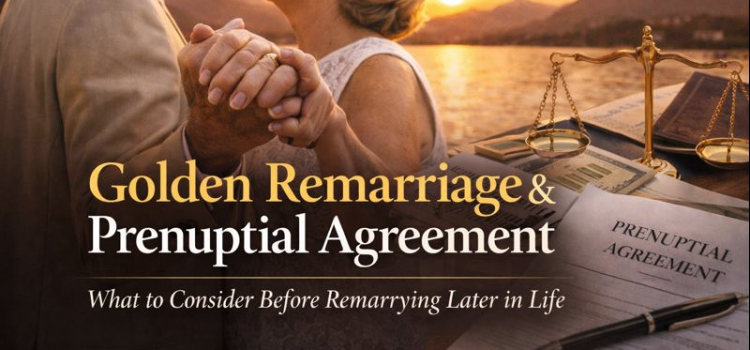
Thinking About a “Golden Remarriage”? Should I Consider a Prenuptial Agreement First?

golden remarriage prenuptial agreement planning later in life

Do I Need a Prenuptial Agreement for a Golden Remarriage in Ohio?

Getting remarried later in life, also commonly referred to as a golden remarriage, or a second-chance romance is on the rise. Marriage for adults after age 60 may occur after the death of a spouse, or after a divorce, or after a life time of devoting oneself to a career and family. Older adults cite various reasons for remarrying. A golden remarriage prenuptial agreement is an important consideration for couples who are thinking about remarrying later in life.

Perhaps it is for the support of someone near their own age, or the concern of spending later years alone. It provides both companionship and intimacy and an increase in socialization. If you decide you want to remarry, congratulations! But before you walk down the aisle, there are many things to consider. Marriage at any age is a commitment, but getting married later in life has additional challenges that need to be addressed.… View Full Article → “Thinking About a “Golden Remarriage”? Should I Consider a Prenuptial Agreement First?”

Estate Planning for Second Marriages

The Need For Proper Estate Planning In Second Marriages

Researched and written by Tammy Chavez, third year law student at the University Of Dayton School Of Law, and a former law Extern for our Firm.

Estate planning Plays A Crucial Role For Second Marriages

Nowadays, second marriages are not uncommon. In fact, 40% of all new marriages involve remarriages. Regardless of the reason for remarriage, estate planning is more important than ever for second marriages. Estate planning plays a crucial role for second marriages, in ensuring a person’s assets are distributed according to his/her wishes.

In order to relieve some of the confusion surrounding estate planning with second marriages, I had the opportunity to discuss this confusing topic with Holzfaster, Cecil, McKnight & Mues’ very own specialist in Estate Planning, Trust and Probate Law, Mr. Joseph Balmer.

In interviewing Mr. Balmer, he stated “three things that I always want to look at are: (1) are we looking to take care of the spouse during her lifetime while also preserving assets for the children of a prior marriage?… View Full Article → “Estate Planning for Second Marriages”

Estate Planning and Probate: The Effect of Titling of Assets

Effective Titling Of Assets Can Benefit Estate Planning Probate Documents

Many people do not understand the distinctions between how one titles one’s assets and the resulting repercussions from it. Properly titling one’s assets can greatly increase the effectiveness of one’s estate plan. Some of these distinctions are described below:

  • Power of Attorney: Adding another individual as power of attorney on an asset does not convey any ownership rights, but allows an agent to manage the asset and utilize it just as if the owner could. The agent is known as your attorney-in-fact. Adding a power of attorney does not keep an asset from having to go through the probate process, but allows an agent to manage the asset (pay bills, etc.) without having to go through a guardianship proceeding.
  • Payable on Death/ Transfer on Death: often confuse Power of Attorney (POA) with Payable on Death (POD) designations. By designating someone as a Payable on Death (POD) beneficiary does not give any rights during the owner’s lifetime but allows the asset to pass directly to the payable on death beneficiary on the death of the owner without having to go through the probate process.
View Full Article → “Estate Planning and Probate: The Effect of Titling of Assets”

Estate Planning: A Truly Sad Story, Prince – His Tragic Death and His Lack of Estate Planning

Singer Prince Passing Proves The Importance Of Estate Planning Documents

As everyone knows by now, sadly, Prince unexpectedly passed away recently. In the days following his untimely death, questions began to arise as to whom would inherit his estate, which some have estimated to be worth between 300 and 500 million dollars. Surely he had a will, experts speculated. He had an army of attorneys working for him.

As it turns out, he apparently died with no estate planning documents in place. When asked how this happened, one of his many attorneys stated “Maybe he didn’t expect to die.” Unfortunately, this is the mindset that many of us have. We never would expect to die so soon.

Lack Of Estate Planning Documents Can Result In Repercussions For Surviving Family Members

Prince died leaving 1 full sister and 6 half siblings. Under Minnesota law, as under Ohio law, the 7 of them will share equally in his estate.… View Full Article → “Estate Planning: A Truly Sad Story, Prince – His Tragic Death and His Lack of Estate Planning”

Estate Planning Tips for Same-Sex Couples

Statutory Protections In Estate Planning Now Available To Surviving Spouses Of Same-Sex Marriages

Now that the institution of marriage has been sanctioned for same-sex couples, estate planning options and benefits that have not been available before can now be utilized to protect and provide for spouses in same-sex marriages.

Surviving spouses have always been provided certain statutory rights to a deceased spouse’s estate so that they are not completely disinherited.  A surviving spouse is entitled to a “family allowance,” usually the first $40,000 of the deceased spouse’s estate.  The surviving spouse is also entitled to the first two automobiles of the deceased spouse, unless specifically bequeathed to someone else.  The surviving spouse may live in the marital residence rent-free for one year.  The surviving spouse has the option to purchase the marital residence.  The surviving spouse can elect to take against the will.  These are just some of the statutory protections now available to surviving spouses of same-sex marriages.… View Full Article → “Estate Planning Tips for Same-Sex Couples”

Estate Planning For The Modern Family – Use Of The QTIP Trust For Second Marriages

As we all know, the typical family from the 1950’s television shows such as “Leave it to Beaver” have become a rarity over the years.  A couple celebrating their golden wedding anniversary is not so commonplace.  Today, approximately fifty percent of all marriages end in divorce.  In the traditional family, estates usually involve wills and the use of “joint and survivorship” ownership between husband and wife or “beneficiary designations” to ensure that upon the death of a spouse everything would pass to the surviving spouse.  However, in today’s modern family, there may be a second or even third spouse and children from prior marriages.  How does an individual take care of his or her current spouse yet protect his/her children from a prior marriage?

The problem with leaving everything outright to one’s spouse in such a family is that the spouse may presumably leave everything to a new spouse or to their own children upon their death, leaving the children from one’s prior marriage with nothing.  … View Full Article → “Estate Planning For The Modern Family – Use Of The QTIP Trust For Second Marriages”

New Strategies To Protecting Assets From Medicaid Through Long Term Health Care Insurance

While not directly on the topic of family law per se, Attorney Joe Balmer, head of the estate planning and probate department at Holzfaster, Cecil, McKnight & Mues, has written an important article on Medicaid planning that warrants reading.

Thanks to Ohio’s Long-term Care Partnership Program, which became effective in September of 2007, it is now possible to protect more of one’s assets from Medicaid spend down through the use of certain long-term health insurance policies. However, certain criteria must be followed and it is important to purchase any such policy from an experienced long-term health care insurance professional.

Long-term health care services include help with activities of daily living, home health care, respite care, hospice care, adult day care, nursing home care and assisted living facility care. Neither Medicare nor most traditional health care insurance plans cover most costs of long-term care.  Statistics show that the current life expectancy of a 65 year old is 18 additional years and in 2005, 5 percent of all people 65 years or older resided in a nursing home. … View Full Article → “New Strategies To Protecting Assets From Medicaid Through Long Term Health Care Insurance”