
Factors The Court Considers In Determining Whether To Award Spousal Support Pt. 1

By Anne Shale   |   April 10th, 2008

When discussing whether or not a Court will award spousal support, formerly known as alimony, to one of the parties in a divorce proceeding, we must first define what spousal support is. Section 3105.18 of the Ohio Revised Code defines “spousal support” as being “any payment or payments to be made to a spouse or former spouse, or to a third party for the benefit of a spouse or former spouse, that is both for sustenance (maintenance or means of livelihood) and for support of the spouse or former spouse.”

Webster’s New World Dictionary does not define “spousal support” but defines “alimony” as “money a court orders paid to a person by that person’s legally separated or divorced spouse”. While the Ohio Revised Code utilizes the term “spousal support” in Chapter 31 relative to Divorce, Annulment, and Dissolution of Marriage, the Internal Revenue Code governing the payment of federal income taxes continues to use the term “alimony” in lieu of the term “spousal support”.… View Full Article → “Factors The Court Considers In Determining Whether To Award Spousal Support Pt. 1”

Need Free Legal Help to Avoid Foreclosure?

By Robert "Chip" Mues   |   April 3rd, 2008

If you are behind on your mortgage payments and facing possible foreclosure on your home, there is an excellent program that the Ohio Attorney General’s office has instituted. The new program is called “Save the Dream”. You can call their hotline for help at 888-404-4764. Hundreds of lawyers statewide have volunteered to provide free legal services for Ohioans to help them avoid foreclosure actions. Be smart and avoid all those predatory lending “quick fix” offers that you see advertised on television or receive in the mail. They will only put you in further trouble!

Share this post!Tweet!function(d,s,id) {var js,fjs=d.getElementsByTagName(s)[0],p=/^http:/.test(d.location)?"http":"https";if ( !d.getElementById(id) ) {js=d.createElement(s);js.id=id;js.src=p+"://platform.twitter.com/widgets.js";fjs.parentNode.insertBefore(js,fjs);}}(document, "script", "twitter-wjs");View Full Article → “Need Free Legal Help to Avoid Foreclosure?”

I Want to Keep the House, But Should I?

By Robert "Chip" Mues   |   March 29th, 2008

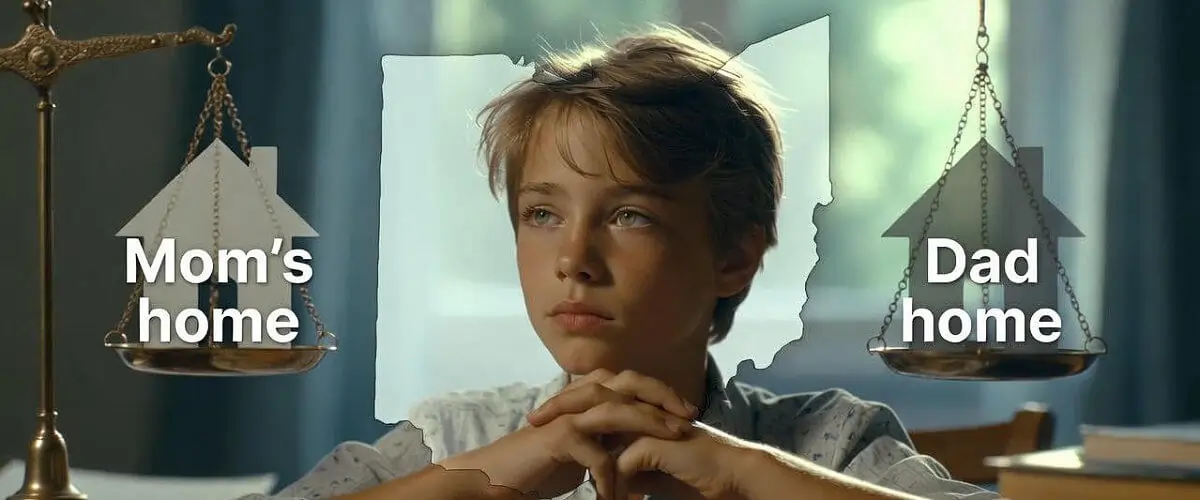
This is one of the questions I am asked all of the time. Of course, the correct answer is “It depends.” The home often accounts for a large percentage of the entire marital estate. Whether to retain the home after a divorce is often a very emotional issue, especially if there are children involved. It is natural that parents want to maintain as much stability for their kids as possible when going through a break up. One would assume that keeping the kids in the marital residence after the divorce is important. But interestingly, the psychological studies show that divorced children are not really affected by the retention of the marital home. The key factor is the stability of their parents, not what house they live in.

It is important to realize that unlike spousal and child support, property division terms cannot by law be changed after the divorce is completed.… View Full Article → “I Want to Keep the House, But Should I?”

The Rise of the Use of Electronic Evidence in Divorce Cases

By Robert "Chip" Mues   |   March 21st, 2008

With the rise of the popularity of the internet, instant messaging, text messaging and the use of GPS systems, electronic evidence is being utilized more and more in litigation. Technology is having a huge impact on our lives and also the way many divorces are being litigated. Recently 88% of the members of the American Academy of Matrimonial Lawyers (AAML) indicated that they have seen an increase in the number of cases using electronic data during the past five years. Emails were the most common form of electronic evidence offered in court according to AAML president, James Hennenhaefer. Electronic evidence is being used for many purposes including detecting hidden assets, financial misconduct and infidelity.

Antonia Love, a solicitor (attorney) from England recently warned the public that social networking sites are becoming the next tool lawyers will be using in divorce proceedings. She said, “People who use social networking websites to send flirtatious emails to people, who are not their partners, are often lulled into a false sense of security that they are doing nothing wrong because correspondence is electronic and therefore isn’t real life.”… View Full Article → “The Rise of the Use of Electronic Evidence in Divorce Cases”

Military Resource Guide

By Robert "Chip" Mues   |   March 17th, 2008

The Army has developed an excellent online resource guide that would benefit new members of all the branches of the armed services, as well as their spouses and their families. It contains a great deal of useful information, including many resources and various checklists. The guide is described as follows:

“This guide introduces new Army spouses and family members to military family life. It contains information on aspects of Army life from military benefits to recreation. It also includes a glossary of Army terms and abbreviations as well as a list of useful Web sites.”

Military OneSource requires that you login on their site in order to access information. You will need to login and search ‘spouse guide’ in order to find the guide titled “A First Guide for Army Spouses and Family Members.” The guide is available to download in PDF format. Click here for the website.

Share this post!Tweet!function(d,s,id)… View Full Article → “Military Resource Guide”

Statistics Regarding Military Divorces

By Robert "Chip" Mues   |   March 13th, 2008

Men and women serving in the armed forces of our country encounter many stresses within their marriages that men and women in the general public do not experience. Long separations from marriage partners and other family members and hardships experienced due to war conditions in Afghanistan and Iraq play havoc on many military marriages. So, it is somewhat surprising that the divorce rate among men and women serving in the military remained steady last year at 3.3 percent. From October 1, 2006, through October 1, 2007, there were 25,000 failed marriages out of approximately 755,000 married active duty troops. These statistics represent members of all military branches.

According to information provided by the Defense Department, members of the Army had a divorce rate of 3.2 percent, a rate which remains unchanged from the previous year. Of the 275,000 married Army soldiers, that amounts to approximately 8,750 divorces. Comparing all branches of the military, it is the Army which has the largest number of troops serving in Afghanistan and Iraq.… View Full Article → “Statistics Regarding Military Divorces”

Antenuptial Agreements, An Effective Estate Planning Tool

By Joseph E. Balmer   |   March 9th, 2008

Antenuptial agreements, also often referred to as prenuptial agreements, are sometimes derided as taking the romance out of marriage and transforming the event and institution into a business arrangement. Some claim that the use of an antenuptial agreement is an acknowledgement that a marriage is likely to fail. However, an antenuptial agreement addresses not only the possibility of divorce, but also the distribution of premarital assets upon the death of one of the spouses. These agreements can be an excellent tool when there is a significant difference in the ages of the parties or in their respective wealth. In situations in which one or both of the parties has/have previously been married and want(s) to preserve assets for his or her children upon death, an antenuptial agreement may be an essential component of a sound estate plan.

There are several basic elements of a valid antenuptial agreement. The agreement must be entered into in writing and signed by both parties in contemplation of an upcoming marriage.… View Full Article → “Antenuptial Agreements, An Effective Estate Planning Tool”

Page 126 of 128
1 122 123 124 125 126 127 128