
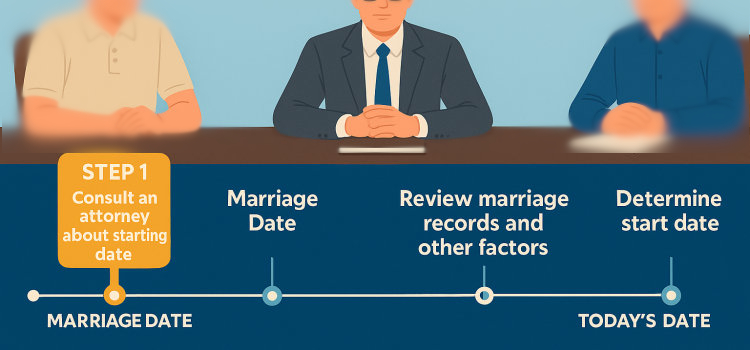
In Divorce Actions of Same-Sex Couples, Do Courts Typically View the Length of the Marriage to Have Started at the Date of Cohabitation or the Later Date of Their Marriage?

chart showing how courts decide same-sex divorce marriage start date

Why the Marriage Start Date Matters in Same-Sex Divorce Cases

In divorce actions involving same-sex couples, one key issue is how courts determine the same-sex divorce marriage start date – whether it begins at cohabitation or the official legal marriage. In 2015, the Supreme Court decided in Obergefell v. Hodges all same-sex couples in the United States have the constitutional right to marry. The case arose from challenges to Michigan, Kentucky, Ohio, and Tennessee laws that banned same-sex marriages and the recognition of legal same-sex marriages that were performed in other states. Click here to read more from our previous blog article.

The Court focused on whether the Constitution’s Fourteenth Amendment requires states to give marriage licenses between same-sex couples and if the Constitution requires states to recognize legally obtained marriage licenses from other states.

The Court held that the right to marry is a “fundamental right” that is “inherent in the liberty” of a person under the Equal Protection Clause of the Fourteenth Amendment, making it unconstitutional for courts to deny same-sex couples the right to marry or recognize marriages performed in other states.… View Full Article → “In Divorce Actions of Same-Sex Couples, Do Courts Typically View the Length of the Marriage to Have Started at the Date of Cohabitation or the Later Date of Their Marriage?”

An Explanation of Ohio’s House Bill 636 – Expanding Marriage Rights in Ohio

Ohio House Bill 636 expanding marriage rights

Understanding the Impact of Ohio House Bill 636 Expanding Marriage Rights on Ohio Residents

Ohio has made significant strides in recent years toward inclusivity and equality, but the journey is far from over according to the sponsors of Ohio House Bill 636 expanding marriage rights, introduced in the Ohio legislature, aims to amend and enact various sections of the Ohio Revised Code to align state laws with federal mandates regarding same-sex and interracial marriages. It is aimed at modernizing Ohio’s legal framework and ensuring that all residents have the right to marry, regardless of race or sexual orientation.

The Goals of Ohio House Bill 636 Expanding Marriage Rights:

At its core, House Bill 636 seeks to eliminate outdated and discriminatory language from Ohio’s Revised Code. One of the most striking amendments is the removal of terms that define marriage strictly as a union between a man and a woman. Instead, the proposed legislation introduces more inclusive language that recognizes same-sex marriages.… View Full Article → “An Explanation of Ohio’s House Bill 636 – Expanding Marriage Rights in Ohio”

Supreme Court Rules: LGBTQ People are Protected from Job Discrimination

discrimination LGBT civil rights act

Divided Supreme Court Rules On Sex Discrimination Protection For LGBT Workers

In a landmark ruling, a divided Supreme Court ruled on June 15, 2020 that the 1964 Civil Rights Act barring sex discrimination in the workplace also protects LGBTQ employees from being fired because of their sexual orientation. The case, Bostock v. Clayton County, Georgia can be accessed by clicking here. The court decided by a 6-3 vote that a key protection of the Civil Rights Act  of 1964 known as Title VII that bars job discrimination because of sex also encompasses discrimination against LGBT workers.

The decision was written by Associate Justice Neil Gorsuch (who was appointed to the Court by President Trump). Chief Justice John Roberts also joined the court’s four liberal justices composing the majority. Dissenting were Associate Justices Samuel Alito, Clarence Thomas and Brett Kavanaugh.

“An employer who fires an individual for being homosexual or transgender fires that person for traits or actions it would not have questioned in members of a different sex,” Justice Neil Gorsuch wrote for the court.View Full Article → “Supreme Court Rules: LGBTQ People are Protected from Job Discrimination”

Study Finds that Same-Sex Weddings have Generated $3.8 billion Over the Last 5 Years

Study Finds that Same-Sex Weddings have Generated $3.8 billion Over the Last 5 Years

Same-Sex weddings Have Generated Billion in Local and State Economic Activity in U.S. According to Study

It is estimated that there are 513,000 married same-sex couples in the United States. There are 28 United Nations’ member states that recognize the right of same-sex individuals to marry.  According to a study released on May 25, 2020 by the Williams Institute on Sexual Orientation and Gender Identity Law at UCLA , same-sex weddings have generated $3.8 billion in local and state economic activity in the United States since the Supreme Court legalized gay marriage five years ago this month in Obergefell v. Hodges. Click here to read the Supreme Court decision.

In June 2015, when the Supreme Court issued its decision in Obergefell, there were an estimated 242,000 same-sex married couples in the U.S. The number of married same-sex couples has more than doubled since then. An estimated 513,000 same-sex couples are married as of March 2020.… View Full Article → “Study Finds that Same-Sex Weddings have Generated $3.8 billion Over the Last 5 Years”

Same Sex Couples Count for the 2020 Census

same sex couples census

Same Sex Couples To Be Tracked In 2020 United States Census

As of 2020, same sex couples will be officially tracked by the United States Census. For the record, same-sex marriage is legal in 19 states and in the District of Columbia. North Dakota has banned it. According to a Pew Research Report, this is the first time the United States Census Bureau will ask specifically for same-sex couples to identify themselves. Other questions on the form include age, sex, Hispanic origin, race, relationship status, homeownership status, and citizenship.

Rather than the usual under-representation faced by the LGBTQ+ community, same sex couples have apparently been over-counted by the Census Bureau. In past counts, the Bureau established the number of same sex couples by combining answers from the question regarding the respondent’s sex, and the question as to whether they had a husband, wife, unmarried partner, or no partner. The Census Bureau then combined those answers and determined whether a couple was considered same-sex or not.… View Full Article → “Same Sex Couples Count for the 2020 Census”

Gay Marriage Alert: Masterpiece Cakeshop Court Case is Finally put to Rest…For Now

same-sex baker supreme court

PUBLISHERS NOTE: I want to thank Ashlyn Gallant, a third year law student at the University of Dayton School of Law, who researched and wrote this same-sex alert blog article. She is externing with us for the summer. Well done Ashlyn!

Supreme Court Rules In Favor Of Baker In Same-Sex Religious Freedom Case

It seems as though it was just yesterday that the news came out stating that a baker in Colorado refused to bake a cake for a same-sex couple’s wedding due to his religious beliefs against same-sex marriage. Outrage broke out on both sides of the spectrum. LGBT+ activists took to their platforms and religious freedom was put to the test. As of June 4, 2018, the case has been decided, but not for the reasons one would think.

The Supreme Court released their decision and as a result, some are in complete disbelief. The Court’s narrow holding allowed the Baker to walk away vindicated after six long years of turmoil.… View Full Article → “Gay Marriage Alert: Masterpiece Cakeshop Court Case is Finally put to Rest…For Now”

Another Same-Sex Parenting Rights Issue Upheld by the U.S. Supreme Court

Alert Key Legal Update

U.S. Supreme Court Upholds Arizona Supreme Court Same-Sex Custody Case Decision

The U.S. Supreme Court declined on February 22, 2018, to hear an appeal of a case where the Arizona Supreme Court found that a lesbian woman should be recognized as the legal parent of the child she and her former wife conceived through artificial insemination during their marriage.

The case, stems from a custody dispute between Kimberly McLaughlin and Suzan McLaughlin.  The couple was legally married in California in 2008, and chose to have a child via artificial insemination and an anonymous sperm donor.  In 2011, Kimberly gave birth to the couple’s son.  Two years later, she left with the child and cut off all communication between Suzan and their son.  Upon filing for divorce, Suzan sought parenting time based upon an Arizona law regarding the presumption of parentage.  Specifically, the law states that a child born to a woman within 10 months of her marriage is presumed to be biologically related to the father.… View Full Article → “Another Same-Sex Parenting Rights Issue Upheld by the U.S. Supreme Court”

Page 1 of 3
1 2 3